Most payment systems operate with a “Legacy Tax” – hidden inefficiencies in authorization routing, checkout friction, and bloated interchange fees.
We don't just find the debt – we architect the recovery.
Legacy payment stacks weren't built for the speed modern commerce demands. Our modular API roadmap slots in without rebuilding everything from scratch. Live in under 14 days and delivers a measurable 20% lift in conversion velocity where friction used to live.


Real engagements. Measurable outcomes. No theoretical frameworks.


The client’s global transaction success rate plummeted below 50%. This wasn't just a technical glitch; it was an "Architectural Drift." Legacy static rules were clashing with evolving bank algorithms, leading to massive revenue leakage.
The Symptom: Over $4M in monthly attempted transactions were failing without a clear "Why".
The Strategic Pivot: Our 14-day audit performed a Forensic Logic Analysis. We bypassed the surface-level "Decline Codes" to categorize failures into a binary framework: Actionable vs. Non-Actionable.
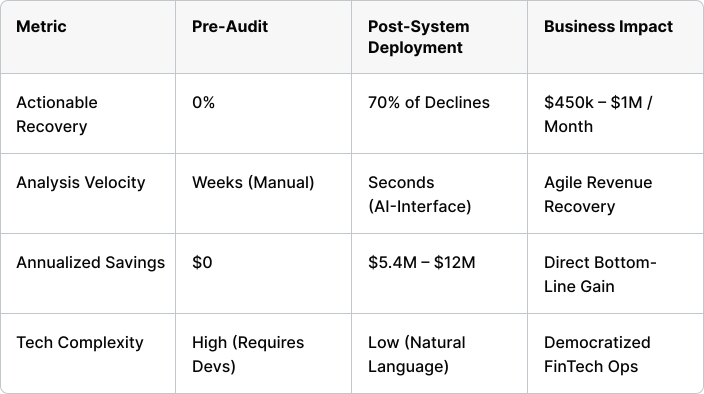
We discovered that 70% of declines were actionable. To capture this, we didn't just write new code; we built a dynamic Heuristic Recommendation Engine.
Pillar A: Deterministic Rule Classification (The "Brain"): We built a classification system using pure statistical analysis (not LLMs) to identify the "Golden Rules" for authorization.The Rationale: LLMs are prone to "hallucinations" in mathematical data analysis. We used deterministic models to identify exactly which parameters (e.g., zip code + currency + time-of-day) would flip a decline to an approval.Result: Identified core rule-sets that targeted the 70% actionable leakage.
The Strategic Pivot: Our 14-day audit performed a Forensic Logic Analysis. We bypassed the surface-level "Decline Codes" to categorize failures into a binary framework: Actionable vs. Non-Actionable.
Pillar B: LLM-Powered Strategic Interface (The "Voice")We utilized a Large Language Model (LLM) as the Interface Layer. This allowed the client’s non-technical finance team to query the complex data model using natural language.
Unlike generalist AI firms that try to "solve payments with GPT-4," we use Math for the Money and LLMs for the People. We proved that a company doesn't need a team of 10 data scientists to manage a $100M money flow; they just need the right Architectural Interface.
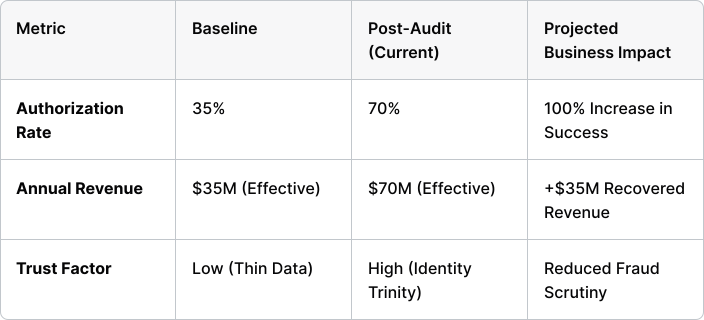
The client was operating at a 35% success rate, effectively losing 6.5 out of every 10 customers at the final millisecond of the journey. In the Japanese market–known for its conservative banking protocols–legacy "thin-data" payloads were being auto-rejected by local issuers as high-risk anomalies.
The Revenue Gap: At $100M/year, this represented a $65M annual opportunity loss.
The Root Cause: A fragmented data architecture that failed to pass essential "Trust Signals" to the acquiring banks.
Our 14-day audit moved beyond code to the "Protocol Layer." We identified that the client’s legacy stack was stripping away the very data points banks use to verify human identity.
Pivot A: Solving the 3DS & Address Logic:
We re-engineered the 3DS handshake and enforced the collection of the Billing Address.
Pivot B: The "Identity Trinity" Breakthrough (The 67% Lift)
We identified the missing link in the Japanese and International banking "Handshake": The Phone Number.
During our audit, we don't just look for bugs; we check your Risk Data Integrity. Most companies are "flying blind," sending incomplete data to the transaction acquirer. We ensure that every transaction carries the "Identity Trinity" necessary to turn a "Decline" into a "Deposit."
The client’s marketing and operations teams noticed a sudden drop in email open rates and a surge in "Spam" flags.
The Symptom: Email providers put the client’s domain under review due to spam alerts - bots were using the client's signup form to register an account and then flooded customers with emails.
The Hidden Threat: The email issues were just a smokescreen. Fraudsters were using the newly created accounts to run Card Testing Attacks, validating thousands of stolen credit cards through the accounts checkouts.
Instead of buying an expensive, "black-box" AI tool that would take months to calibrate, we used Statistical Pattern Matching during our audit to surgically remove the botnet.
Pivot A: Pattern Identification & Scale Analysis:
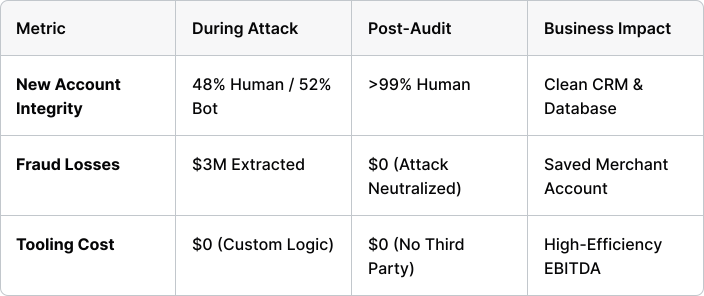
We analyzed the signup metadata and discovered that 52% of all new accounts in a 30-day window were non-human.
Pivot B: Stopping the $3M "Carding" Leak:
The fraudsters had already successfully validated and extracted $3M from stolen cards using the client's gateway, putting the merchant account at risk of immediate termination by Visa/Mastercard.
We didn't just stop a bot; we saved the client’s Merchant Relationship. If a processor sees $3M in card testing, they don't just fine you - they shut you down.
Is your email reputation or merchant account currently at risk from undetected card-testing? Let’s set up a call this week to review your flow and discuss a 14-day path to permanent protection.